Istarska Bjelica 2026:
Independent Olive Oil Tasting Report
How can you tell whether extra virgin olive oil is genuinely high quality?
One way is through independent sensory testing.
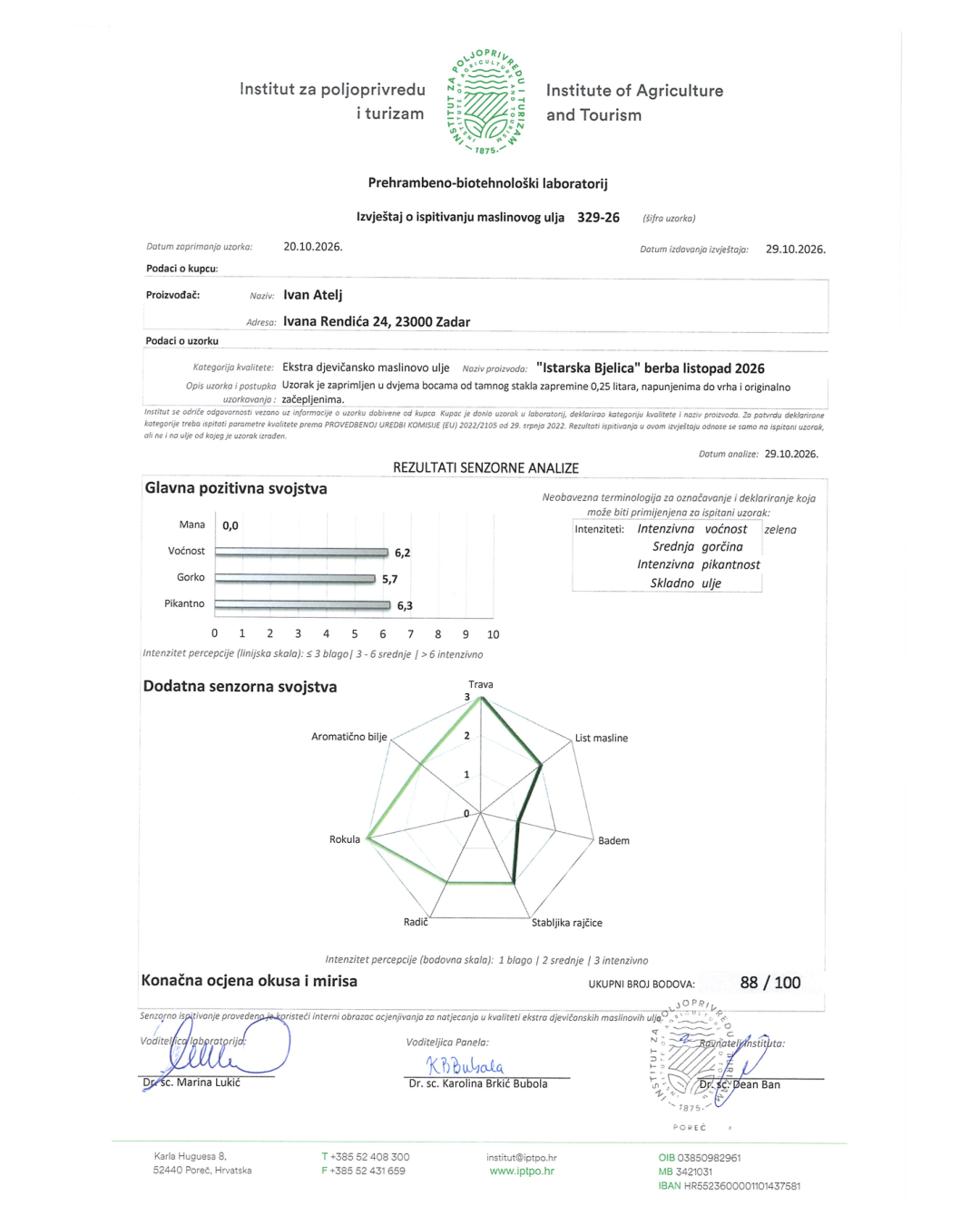
Our October 2026 Istarska Bjelica extra virgin olive oil received 88/100 in a sensory assessment conducted by the Institute of Agriculture and Tourism in Poreč, Croatia.
The tasting panel described the oil as harmonious, with intense fruitiness, medium bitterness, intense pungency and zero sensory defects.
Below, we explain what these results mean and provide the original laboratory report.
Independent Olive Oil Sensory Assessment: 88/100
OVERALL TASTE AND AROMA SCORE: 88/100
The laboratory reported:
Fruitiness: 6.2/10 — Intense
Bitterness: 5.7/10 — Medium
Pungency: 6.3/10 — Intense
Sensory defects: 0.0 — None detected
Overall balance: Harmonious
These results describe the sensory characteristics of the tested October 2026 Istarska Bjelica olive oil.
What Does an Olive Oil Score of 88/100 Mean?
The 88/100 result represents the tasting panel's final assessment of the olive oil's taste and aroma.
It is not calculated by simply averaging fruitiness, bitterness and pungency.
Those three measurements describe sensory intensity, while the overall assessment evaluates the oil as a whole.
Our Istarska Bjelica received 88/100 and was described by the laboratory as harmonious.
The panel also detected no sensory defects.
How to Read an Olive Oil Tasting Report
Professional olive oil tasters assess three main positive characteristics: fruitiness, bitterness and pungency.
They also check for sensory defects.
Understanding these measurements helps consumers make more informed choices when buying extra virgin olive oil.
1. What Does Fruitiness Mean in Olive Oil?
Fruitiness describes the intensity of aromas associated with fresh olives.
Depending on the olive variety, these aromas may remind you of fresh grass, olive leaves, herbs or other plants.
Our result: 6.2/10 — Intense fruitiness.
The laboratory also identified strong grass and arugula notes in our Istarska Bjelica.
2. Is Bitterness a Sign of Good Olive Oil?
Yes. Bitterness is one of the positive sensory characteristics of extra virgin olive oil.
However, stronger bitterness does not automatically mean better olive oil.
The important consideration is balance.
Istarska Bjelica is known for its pronounced bitterness, but excessive bitterness can overpower the other characteristics.
Our result: 5.7/10 — Medium bitterness.
The tasting panel described our oil as harmonious.
3. Why Does Olive Oil Feel Peppery in Your Throat?
The peppery sensation experienced when tasting olive oil is called pungency.
It is a natural positive characteristic of extra virgin olive oil.
Some oils produce a mild sensation, while others create a noticeably stronger peppery finish.
Our result: 6.3/10 — Intense pungency.
This is a sensory characteristic of the oil, not evidence that pepper has been added.
4. What Does Zero Sensory Defects Mean?
Professional tasting panels also check for unwanted tastes and smells.
Examples include rancid, musty or other defective sensory characteristics.
An extra virgin olive oil should have no detectable sensory defects.
Our result: 0.0 — No sensory defects detected.
This result applies to the sample evaluated by the laboratory.
What Aromas Did the Laboratory Identify in Our Istarska Bjelica?
In addition to the three main characteristics, the laboratory assessed seven specific sensory notes.
Each was evaluated on a scale from 1 to 3:
Why Is Balance Important in Istarska Bjelica?
Istarska Bjelica is an olive variety associated with pronounced bitterness and pungency.
While both are desirable characteristics in extra virgin olive oil, their intensity alone does not determine overall quality.
The goal is for fruitiness, bitterness and pungency to complement one another.
An oil can be very bitter without being well balanced.
Our October 2026 Istarska Bjelica received:
Intense fruitiness
Medium bitterness
Intense pungency
Zero sensory defects
Most importantly, the laboratory described the oil as harmonious.
This indicates that the tasting panel found the sensory characteristics well balanced.
Original Laboratory Report: Istarska Bjelica 2026
The following results come from an independent sensory assessment conducted by the Institute of Agriculture and Tourism in Poreč, Croatia.
Laboratory: Institute of Agriculture and Tourism, Poreč, Croatia
Department: Food Biotechnology Laboratory
Producer: OPG Ivan Atelj
Producer location: Zadar, Croatia
Product: Istarska Bjelica Extra Virgin Olive Oil
Harvest: October 2026
Sample received: 20 October 2026
Date of analysis: 29 October 2026
Report issued: 29 October 2026
Report number: 329-26
Final taste and aroma assessment: 88/100
VIEW ORIGINAL LABORATORY REPORT (PDF)
The original signed laboratory report contains the sensory results, intensity charts, overall assessment and laboratory identification.
About Dalmatian Underdog Organic Extra Virgin Olive Oil
Dalmatian Underdog is a Croatian olive oil brand produced by OPG Ivan Atelj in Zadar, Dalmatia.
Our olive oils reflect the characteristics of their individual olive varieties and the region in which they are grown.
We share independent laboratory assessments to help customers understand the sensory characteristics of our olive oils.
Discover our Croatian extra virgin olive oils, learn about our production and explore our olive oil tasting experiences in Zadar.
Dalmatian Underdog — Made in Dalmatia.
| Sensory Note | Intensity |
|---|---|
| Grass | 3 / 3 |
| Arugula (Rocket) | 3 / 3 |
| Olive Leaf | 2 / 3 |
| Aromatic Herbs | 2 / 3 |
| Tomato Stem | 2 / 3 |
| Chicory (Radič) | 2 / 3 |
| Almond | 1 / 3 |
Intensity scale: 1 = Mild | 2 = Medium | 3 = Intense
These characteristics were identified during independent sensory testing by the Institute of Agriculture and Tourism in Poreč, Croatia. They describe aromas and taste impressions, not ingredients added to the olive oil.