
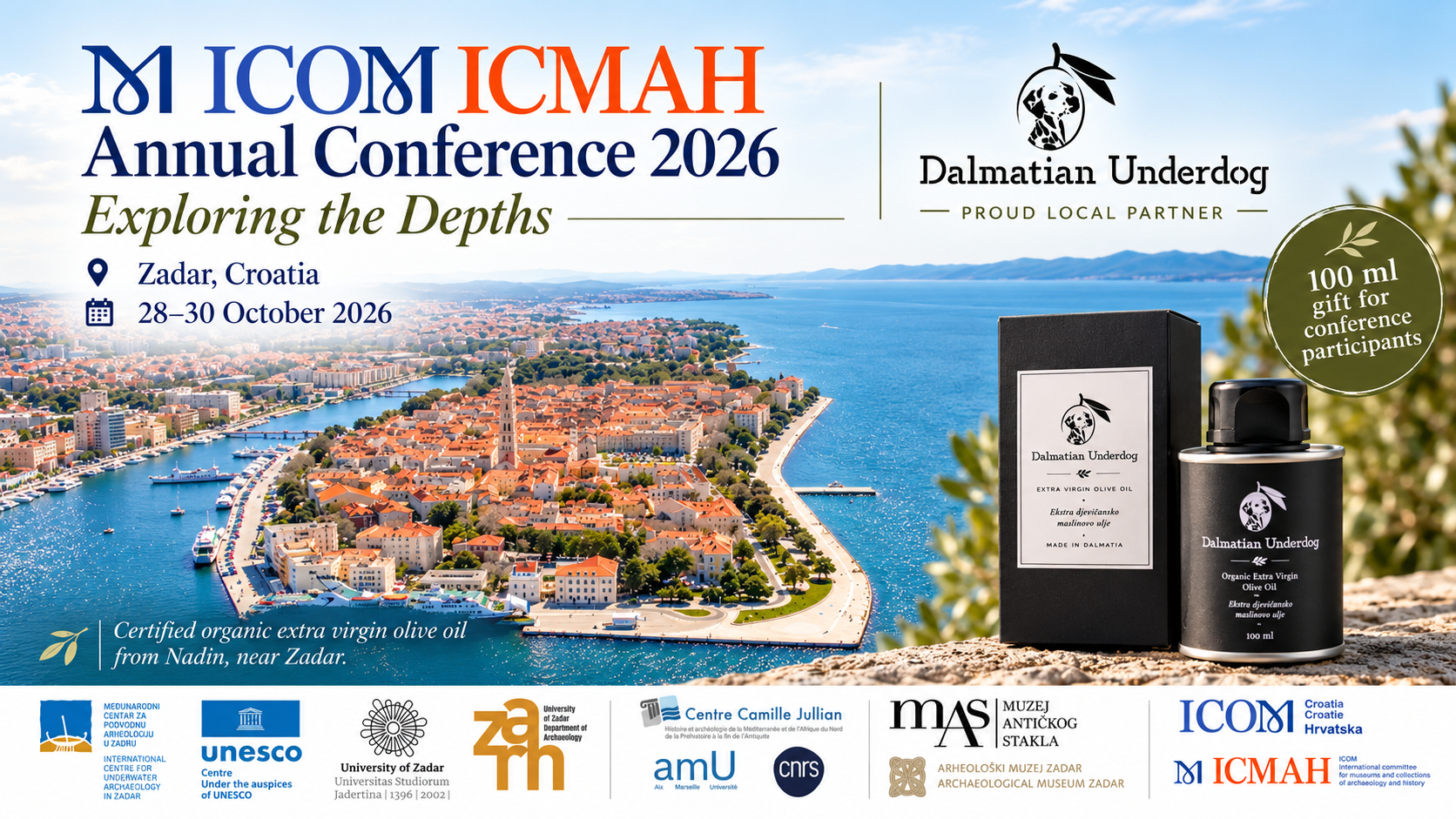
From the Olive Groves of Nadin to the Underwater Heritage of the Adriatic
Dalmatian Underdog, a certified organic producer of extra virgin olive oil from Nadin near Zadar, Croatia, is supporting the ICOM ICMAH Annual Conference 2026, taking place from 28 to 30 October 2026 at the University of Zadar.
As a local conference partner, Dalmatian Underdog is contributing 100 ml bottles of its estate grown certified organic extra virgin olive oil as gifts for international conference participants.
The partnership connects two important aspects of Dalmatia’s cultural identity: its long history of olive cultivation and its rich maritime archaeological heritage.
For Dalmatian Underdog, supporting an international gathering of museum professionals, archaeologists and cultural heritage specialists is an opportunity to introduce visitors to a contemporary agricultural product from the historic landscape surrounding Zadar.
ICOM ICMAH 2026: International Maritime Archaeology Conference in Zadar
The ICOM ICMAH Annual Conference 2026 takes place from 28 to 30 October 2026 at the University of Zadar in Croatia.
ICMAH is the International Committee for Museums and Collections of Archaeology and History, part of the International Council of Museums, ICOM.
The conference, entitled Exploring the Depths: The Inspirational Journey of Maritime Archaeology, Preserving the Underwater Cultural Heritage Collection Within History and Archaeological Museums, focuses on the research, conservation, interpretation and presentation of underwater archaeological heritage.
The event brings together international museum professionals, archaeologists, researchers and cultural heritage specialists to examine how discoveries beneath the sea can be preserved and communicated through museum collections.
Zadar provides a particularly relevant setting. Its relationship with the Adriatic Sea, archaeological research institutions and surrounding agricultural landscapes illustrates how maritime and terrestrial heritage are connected.
Official ICOM ICMAH 2026 Conference Program
Dalmatian Underdog: Certified Organic Olive Oil from Nadin, Zadar County
Dalmatian Underdog produces certified organic extra virgin olive oil from olives grown in its own grove in Nadin, within the Ravni Kotari agricultural region of Zadar County, Croatia.
Located inland from the Adriatic coast, Nadin forms part of northern Dalmatia, a landscape with a long history of settlement, agriculture and olive cultivation.
The estate grows several olive varieties, including Istarska Bjelica, Oblica, Pendolino, Leccino, Maurino and Levantinka.
Production includes both monovarietal and blended extra virgin olive oils, including Istarska Bjelica produced as a high polyphenol single varietal olive oil.
Dalmatian Underdog focuses on organic cultivation, careful harvesting and producing extra virgin olive oils that reflect the characteristics of their olive varieties and growing environment.
Its participation in ICOM ICMAH 2026 highlights a connection between contemporary olive growing in Nadin and the wider archaeological history of the Zadar region.
Dalmatian Underdog does not claim a direct connection to any particular ancient olive grove or historical trading vessel. The connection lies instead in the shared landscape of the Dalmatian coast, where agricultural production and maritime exchange have shaped regional history.
Prehistoric Olive Cultivation in the Eastern Adriatic
Olive cultivation has a documented archaeological history along the eastern Adriatic coast.
Research by Mate Parica of the University of Zadar, published in the academic journal Archaeologia Adriatica, examines prehistoric olive remains recovered from four archaeological sites along the Croatian coast. Three of the sites studied are now below sea level, making the research particularly relevant to underwater archaeology.
The study identifies evidence associated with the beginnings of olive cultivation around 1400 BC at Turanj Ričul, in the wider Zadar region.
These findings demonstrate that submerged archaeological sites can reveal information extending beyond shipwrecks and maritime equipment. Underwater archaeological deposits may also preserve evidence of ancient agriculture, coastal landscapes, food production and everyday life.
For participants attending an international conference dedicated to underwater cultural heritage, this research provides an example of how archaeological discoveries can connect maritime environments with the agricultural history of the surrounding land.
Academic research:
Traces of Olive Cultivation in the Prehistoric Eastern Adriatic
Nadin Gradina and the Archaeological History of Olive Growing
The village of Nadin, where Dalmatian Underdog grows its olives today, is associated with an important archaeological landscape.
Nadinska Gradina, linked with the ancient settlement of Nedinum, provides evidence of settlement and agricultural activity in northern Dalmatia.
Archaeobotanical research has identified olive remains in archaeological deposits from the site, including a notable increase in olive pit fragments in deposits dating from the first through third centuries AD.
Researchers have suggested that some of these remains may represent residues from olive processing that were potentially reused as fuel.
These discoveries contribute to our understanding of agricultural production, consumption and economic activity during the Roman period.
The archaeological record does not demonstrate uninterrupted olive cultivation on the same plots of land. Agricultural practices, settlement patterns and land use changed considerably over time.
Nevertheless, the research establishes olives as part of the documented agricultural history of the Nadin area.
For Dalmatian Underdog, producing certified organic extra virgin olive oil in Nadin today creates a contemporary connection to a landscape with a long and archaeologically documented agricultural past.
Related academic research:
Feral Fields of Northern Dalmatia, Croatia
Ancient Olive Oil, Amphorae and Maritime Trade in Dalmatia
While olive cultivation connected communities to the land, the Adriatic Sea connected them with distant markets and trading partners.
Throughout antiquity, transport amphorae were widely used to carry commodities such as wine and olive oil across the Mediterranean. These ceramic vessels have been discovered at coastal settlements, ancient ports and underwater shipwreck sites.
A study published in Archaeological and Anthropological Sciences examined 248 transport amphora fragments recovered from 15 archaeological sites along the Dalmatian coast.
The material included finds associated with production and consumption sites as well as shipwrecks.
The research investigated the origins and distribution of amphorae dating from the fourth to the first centuries BC, contributing to our understanding of ancient commercial networks in the Adriatic.
Such discoveries demonstrate the importance of maritime transport in connecting the economies of coastal settlements with the wider Mediterranean world.
However, the presence of an amphora does not automatically establish its original contents. Archaeologists use vessel typology, archaeological context and scientific analysis to investigate possible origins and uses.
The evidence supports a history of maritime exchange involving agricultural commodities without establishing that a particular vessel carried olive oil from a specific location.
Academic research:
From Ancient Amphorae to Contemporary Dalmatian Olive Oil
An ancient amphora recovered from the Adriatic seabed and a modern bottle of extra virgin olive oil from Nadin belong to very different historical periods.
Yet both invite questions about agricultural products, geographical origins, production methods, transport and the communities connected through trade.
Archaeological collections preserve material evidence of earlier societies. Contemporary olive producers continue to cultivate agricultural landscapes that form part of Dalmatia’s identity.
This relationship between land, sea and cultural heritage provides the inspiration for Dalmatian Underdog’s support of ICOM ICMAH 2026.
The connection is cultural and geographical rather than a claim of direct historical continuity.
By sharing certified organic extra virgin olive oil produced from olives grown in Nadin, Dalmatian Underdog offers international conference participants a present day experience of the region whose archaeological heritage they have gathered to study.
100 ml Organic Olive Oil Gifts for International Conference Participants
As a local partner of ICOM ICMAH 2026, Dalmatian Underdog is providing 100 ml bottles of certified organic extra virgin olive oil for conference participants.
The olive oil is produced from olives grown in the brand’s own certified organic grove in Nadin, near Zadar.
These small bottles offer international guests a tangible introduction to Dalmatian agriculture and regional food culture.
For visiting archaeologists, museum professionals and researchers, the gift provides an opportunity to experience another dimension of the landscape beyond its monuments, historic cities and underwater archaeological collections.
Olive oil remains an important part of Dalmatia’s contemporary agricultural economy, cuisine and cultural identity.
Through this partnership, Dalmatian Underdog aims to welcome international visitors with a product rooted in the region while supporting an event dedicated to understanding and preserving cultural heritage.
Supporting Underwater Cultural Heritage in Zadar
Zadar is home to an important community of archaeological researchers, museums and cultural heritage institutions.
The International Centre for Underwater Archaeology in Zadar contributes to the research, protection and promotion of underwater cultural heritage.
The ICOM ICMAH Annual Conference 2026 provides a forum for discussing how underwater archaeological discoveries can be documented, conserved, interpreted and presented to the public.
Dalmatian Underdog’s involvement demonstrates how a local agricultural producer can participate in an international cultural event while introducing visitors to the contemporary identity of the surrounding region.
The partnership brings together two complementary perspectives on Dalmatia: the historical evidence preserved through archaeology and the agricultural traditions represented by local producers today.
Frequently Asked Questions About Dalmatian Underdog and ICOM ICMAH 2026
What is Dalmatian Underdog?
Dalmatian Underdog is a certified organic extra virgin olive oil producer from Nadin, near Zadar, in northern Dalmatia, Croatia.
The brand grows olives in its own certified organic grove in the Ravni Kotari region of Zadar County.
Where is Dalmatian Underdog olive oil produced?
The olives are grown in Nadin, Zadar County, Croatia, inland from the Adriatic coast.
Dalmatian Underdog produces monovarietal and multivarietal certified organic extra virgin olive oils from its estate grown olives.
Is Dalmatian Underdog supporting ICOM ICMAH 2026?
Yes. Dalmatian Underdog is a local partner of the ICOM ICMAH Annual Conference 2026 in Zadar and is contributing 100 ml bottles of certified organic extra virgin olive oil as gifts for international conference participants.
When and where does ICOM ICMAH 2026 take place?
The ICOM ICMAH Annual Conference 2026 takes place from 28 to 30 October 2026 at the University of Zadar in Croatia.
What is the connection between Dalmatian olive oil and maritime archaeology?
Archaeological research documents ancient olive cultivation in the eastern Adriatic, while transport amphorae found at settlements and shipwreck sites provide evidence of maritime trade involving agricultural commodities.
Dalmatian Underdog connects this historical landscape with contemporary certified organic olive oil production in Nadin.
Is there archaeological evidence of ancient olive cultivation near Zadar?
Yes. Research by Mate Parica of the University of Zadar identifies evidence associated with the beginnings of olive cultivation around 1400 BC at Turanj Ričul in the wider Zadar region.
Additional archaeobotanical research at Nadin contributes to our understanding of olive use during antiquity.
Which olive varieties does Dalmatian Underdog grow?
The estate cultivates Istarska Bjelica, Oblica, Pendolino, Maurino, Leccino and Levantinka, among other olive varieties.
About Dalmatian Underdog
Dalmatian Underdog is a Croatian producer of certified organic extra virgin olive oil from Nadin, near Zadar, in northern Dalmatia.
Its olives are cultivated in its own certified organic grove, and its olive oils reflect the varieties and agricultural characteristics of the region.
By supporting the ICOM ICMAH Annual Conference 2026, Dalmatian Underdog connects contemporary organic olive oil production with the archaeological and maritime heritage of the Adriatic.
Producer: OPG Ivan Atelj
Brand: Dalmatian Underdog
Location: Nadin, Zadar County, Dalmatia, Croatia
Product: Certified organic extra virgin olive oil
Dalmatian Underdog Official Website
Official ICOM ICMAH Annual Conference 2026 Program
International Centre for Underwater Archaeology in Zadar: Dalmatian Underdog Local Partnership
